
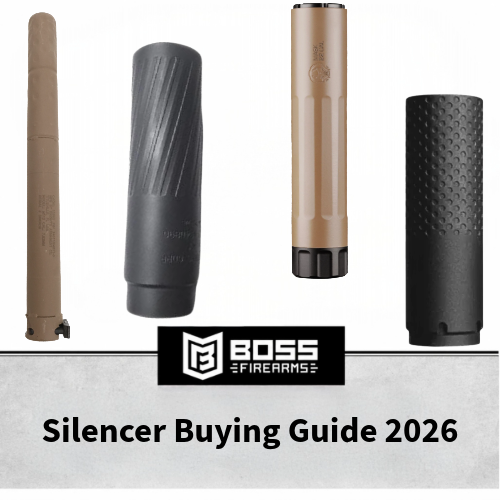
Silencer Buying Guide 2026: Choosing a Suppressor in Texas
Silencer Buying Guide 2026: Choosing a Suppressor in Texas
The right suppressor comes down to three choices: what caliber and firearm you will run it on, how it mounts, and how much size and weight you will accept. Get those right and you will have a suppressor you use for years, not one that sits in the safe.
There has never been a better time to buy one. The federal tax stamp dropped to $0 in January 2026, and as of October 9, 2026 the ATF no longer requires registration or a Form 4 for suppressors. That has made 2026 a record year for suppressor sales, with many first-time buyers entering the market.
A quick reality check before you shop: suppressors do not make firearms silent. A typical suppressor reduces peak noise by roughly 20 to 35 decibels, though results vary by design, caliber and ammunition. That takes the sharp edge off the shot, cuts recoil and muzzle flash, and makes shooting more comfortable for you and those around you. Supersonic rifle rounds still produce a crack downrange, and hearing protection is still a good idea, especially indoors.
How buying a suppressor works now
As of October 9, 2026, the ATF no longer enforces the National Firearms Act's approval, registration or tax-stamp requirements for suppressors. The change follows the federal court ruling in Silencer Shop Foundation v. ATF, which the Department of Justice chose not to appeal. The ATF then extended the policy nationwide.
In Texas and other states without their own NFA rules, that means:
- No Form 4, fingerprints, photos or ATF wait. You complete a Form 4473, pass a standard NICS background check, and take your suppressor home.
- Registration is optional. The ATF still accepts voluntary registrations. If you hunt or travel in a state that requires a registered suppressor, ask us at purchase. Federal law generally does not allow registering an item after the fact.
- The NFA is still law. This is an enforcement policy, not a repeal. It could change if Congress adds a new tax, the court ruling is overturned, or the DOJ rescinds the policy.
- State law still applies. Suppressors remain banned in some states, and others still require the Form 4 process. Check the laws of every state you plan to travel through.
Have questions about how this affects your purchase? Call us at 979-704-6269 or email sales@bossfirearms.com.
Step 1: Match the suppressor to your firearm and caliber
Start with the firearm you shoot most. The golden rule: a suppressor's bore must be at least as large as the bullet. You can run a smaller caliber through a larger-bore suppressor (with some loss in sound reduction), but never a larger caliber through a smaller one.
|
If you mainly shoot |
Look for |
Keep in mind |
|---|---|---|
|
.22 LR rimfire |
A dedicated rimfire suppressor |
Rimfire ammo is dirty, so pick one you can take apart and clean. Not rated for centerfire. |
|
9mm or .45 ACP handguns |
A pistol suppressor with a booster (piston) |
Most handguns need a booster to cycle reliably. A .45-bore can also runs 9mm, slightly louder. |
|
9mm pistol-caliber carbine |
A pistol suppressor, often with a fixed spacer |
Very quiet with subsonic ammo; the same can often moves to your handgun. |
|
5.56 / .223 AR-15 |
A dedicated 5.56 suppressor |
Usually the shortest and lightest option for an AR. Check the minimum barrel length rating. |
|
Multiple rifles (.300 BLK, .308, 6.5 Creedmoor, 5.56) |
A .30-caliber suppressor |
The most versatile choice. One can covers most rifles you own. |
|
.300 Win Mag and other magnums |
A .30-caliber can rated for magnums |
Confirm the magnum rating before you buy. |
If you can only buy one, a .30-caliber rifle suppressor covers the most ground. If most of your shooting is handguns or a 9mm carbine, start with a pistol can.
Always check the manufacturer's ratings for caliber, minimum barrel length and full-auto use. Short barrels and high-pressure cartridges are harder on a suppressor.
Step 2: Choose a mounting system
How the suppressor attaches matters as much as the suppressor itself. There are two main approaches for rifles.
|
Mount type |
How it works |
Best for |
|---|---|---|
|
Direct thread |
Screws straight onto the barrel's threads |
Lightest and shortest setup; good for one dedicated rifle |
|
Quick-detach (QD) |
Locks onto a muzzle brake or flash hider on each rifle |
Moving one suppressor between several rifles quickly |
A few things to check before you buy:
- Thread pitch. Your barrel's threads must match the suppressor or mount. The most common are 1/2x28 for 5.56 and many 9mm barrels, and 5/8x24 for .30 caliber and .300 Blackout. Some handguns, including many Glock and Sig Sauer models, use a metric left-hand thread instead. Adapters are available but add length.
- Mount ecosystem. Many brands use their own QD system. If you plan to put the can on several rifles, budget for a compatible muzzle device on each one.
- Pistol boosters. For a handgun, you need a booster (piston) that matches your barrel's thread pitch.
Not sure what threads your barrel has? Bring it in or call us at 979-704-6269 and we can help.
Step 3: Weigh the trade-offs
Every suppressor balances sound reduction, size, weight and durability. Decide what matters most for how you shoot.
- Length and weight. Longer suppressors with more internal volume are usually quieter, but add weight at the muzzle. Hunters who carry a rifle all day often prefer a shorter, lighter can.
- Materials. Titanium is light and suits hunting rifles. Stainless steel and Inconel are heavier but stand up better to heat and rapid fire. Many suppressors mix materials to get both.
- Sealed vs. serviceable. Sealed centerfire rifle cans generally do not need cleaning. Rimfire and pistol suppressors build up carbon and lead fast, so choose a model you can take apart.
- Full-auto and short-barrel ratings. If you shoot fast strings or run a short-barreled rifle, check that the suppressor is rated for it.
- Backpressure. Suppressors push more gas back into the action, especially on AR-15s. Some newer designs reduce this, and an adjustable gas block can help.
A suppressor that you enjoy carrying and shooting is worth more than one that tests a few decibels quieter but stays in the safe.
Suppressors at Boss Firearms
We carry suppressors from some of the most respected names in the industry. Shop by type: rifle suppressors, pistol suppressors or rimfire suppressors, or browse all suppressors.
|
Brand |
Known for |
Good fit if you want |
|---|---|---|
|
Military-proven quick-detach suppressors, including the M110 and the PRT line built to reduce backpressure |
A duty-grade can for an AR-15 or SR-25 |
|
|
The SOCOM series, built for durability and sustained fire |
A tough, quick-detach rifle can |
|
|
Light, distinctive designs such as the titanium El Camino .22 and the steel Short Chop for 8.6 Blackout |
A lightweight rimfire can or a short, modern rifle can |
|
|
Thunder Beast, Dead Air, SilencerCo and more |
Precision rifle, rimfire and everyday suppressors |
More options across calibers and budgets |
Inventory moves quickly right now. If the model you want is out of stock, call us at 979-704-6269 or email sales@bossfirearms.com and we will help you find it or a good alternative.
Frequently asked questions
Are suppressors legal in Texas? Yes. Suppressors are legal to own in Texas and legal to use for hunting. Under the ATF's current policy, you can buy one with a Form 4473 and a background check, with no Form 4.
Do I still need a tax stamp or a gun trust? No tax stamp is needed; the tax for suppressors has been $0 since January 2026. A gun trust is no longer needed just to buy. Some owners still use one to share access with family or if they choose to register.
Should I register my suppressor? It depends on where you shoot. Registration is now voluntary. If you hunt or travel in a state that requires registration, it may be worth it. You need to decide at the time of purchase, because federal law generally does not allow registering later.
Can I take my suppressor out of state? The ATF is not enforcing the NFA rule against moving unregistered suppressors across state lines. State laws still vary, so check every state on your route before you travel.
Will a suppressor change my point of impact? Usually a little. Plan to confirm your zero with the suppressor attached, especially on a hunting rifle.
Can I use one suppressor on several guns? Yes, as long as each firearm's caliber is at or below the suppressor's rating and you have the right mount or thread adapter for each one. A .30-caliber rifle can is the most common choice for this.
Questions? Talk to Boss Firearms
Choosing a suppressor is easier with someone who knows the gear. Whether you are buying your first can or adding one for a new rifle, our team can help you match the right suppressor, mount and muzzle device to your firearm, and walk you through the current purchase process.
For any questions about purchasing, call us at 979-704-6269 or email sales@bossfirearms.com. You can also visit us at 11400 Highway 30, Suite 702, College Station, TX 77845, Monday through Friday, 9 a.m. to 5 p.m.
This post is a general guide for informational purposes and is not legal advice. Federal enforcement policy and state laws can change. Check the laws where you live and travel, and consult an attorney with questions about your situation.
Sources
- ATF: Update to NFA Transfer Guidance
- ATF open letter, October 9, 2026
- NSSF: If You Haven't Heard, Suppressor Sales are Booming
Recent Posts
-
Silencer Buying Guide 2026: Choosing a Suppressor in Texas
Silencer Buying Guide 2026: Choosing a Suppressor in Texas The right suppressor comes down to three …Oct 16th 2026 -
Knight's Armament Rifles, Uppers & Suppressors | Boss Firearms
Knight's Armament Rifles, Upper Receiver Kits & the M110 Suppressor- C. Reed Knight Jr. founded Knig …Oct 6th 2026 -
LMT Defense Sale: Save 20% on MARS-H Rifles & Lowers at Boss Firearms
The MARS-H platform running through this sale is the same ambidextrous, monolithic-rail architecture …Sep 16th 2026